Considering Question F9 Again What Is the Probability of Producing a Ponk Eyed Straig
Question 32 a i - Sample
The directors of Pelta Co are considering a planned investment project costing $25m, payable at the start of the first year of operation. The following information relates to the investment project:
| Year 1 | Year 2 | Year 3 | Year 4 | |
|---|---|---|---|---|
| Sales volume (units/year) | 520,000 | 624,000 | 717,000 | 788,000 |
| Selling price ($/unit) | 30·00 | 30·00 | 30·00 | 30·00 |
| Variable costs ($/unit) | 10·00 | 10·20 | 10·61 | 10·93 |
| Fixed costs ($/year) | 700,000 | 735,000 | 779,000 | 841,000 |
This information needs adjusting to take account of selling price inflation of 4% per year and variable cost inflation of 3% per year.
The fixed costs, which are incremental and related to the investment project, are in nominal terms. The year 4 sales volume is expected to continue for the foreseeable future.
Pelta Co pays corporation tax of 30% one year in arrears. The company can claim tax-allowable depreciation on a 25% reducing balance basis.
The views of the directors of Pelta Co are that all investment projects must be evaluated over four years of operations, with an assumed terminal value at the end of the fourth year of 5% of the initial investment cost.
Both net present value and discounted payback must be used, with a maximum discounted payback period of two years. The real after-tax cost of capital of Pelta Co is 7% and its nominal after-tax cost of capital is 12%.
Required:
(a) (i) Calculate the net present value of the planned investment project. (9 marks)
1101 others have taken this question
Question 32 b - Sample
Vyxyn Co is evaluating a planned investment in a new product costing $20m, payable at the start of the first year of operation. The product will be produced for four years, at the end of which production will cease. The investment project will have a terminal value of zero. Financial information relating to the investment project is as follows:
| Year | 1 | 2 | 3 | 4 |
|---|---|---|---|---|
| Sales volume (units/year) | 440,000 | 550,000 | 720,000 | 400,000 |
| Selling price ($/unit) | 26·50 | 28·50 | 30·00 | 26·00 |
| Fixed cost ($/year) | 1,100,000 | 1,121,000 | 1,155,000 | 1,200,000 |
These selling prices have not yet been adjusted for selling price inflation, which is expected to be 3·5% per year. The annual fixed costs are given above in nominal terms.
Variable cost per unit depends on whether competition is maintained between suppliers of key components. The purchasing department has made the following forecast:
| Competition | Strong | Moderate | Weak |
|---|---|---|---|
| Probability | 45% | 35% | 20% |
| Variable cost ($/unit) | 10·80 | 12·00 | 14·70 |
The variable costs in this forecast are before taking account of variable cost inflation of 4·0% per year.
Vyxyn Co can claim tax-allowable depreciation on a 25% per year reducing balance basis on the full investment cost of $20m and pays corporation tax of 28% per year one year in arrears.
It is planned to finance the investment project with an issue of 8% loan notes, redeemable in ten years' time. Vyxyn Co has a nominal after-tax weighted average cost of capital of 10%, a real after-tax weighted average cost of capital of 7% and a cost of equity of 11%.
Required:
(b) Calculate the expected net present value of the investment project and comment on its financial acceptability and on the risk relating to variable cost. (9 marks)
1153 others have taken this question
Question 31 a i b - Specimen
PV Co, a large stock-exchange-listed company, is evaluating an investment proposal to manufacture Product W33, which has performed well in test marketing trials conducted recently by the company's research and development division. Product W33 will be manufactured using a fully-automated process which would significantly increase noise levels from PV Co's factory. The following information relating to this investment proposal has now been prepared:
| Initial investment | $2 million |
|---|---|
| Selling price (current price terms) | $20 per unit |
| Expected selling price inflation | 3% per year |
| Variable operating costs (current price terms) | $8 per unit |
| Fixed operating costs (current price terms) | $170,000 per year |
| Expected operating cost inflation | 4% per year |
The research and development division has prepared the following demand forecast as a result of its test marketing trials. The forecast reflects expected technological change and its effect on the anticipated life-cycle of Product W33.
| Year | 1 | 2 | 3 | 4 |
|---|---|---|---|---|
| Demand (units) | 60,000 | 70,000 | 120,000 | 45,000 |
It is expected that all units of Product W33 produced will be sold, in line with the company's policy of keeping no inventory of finished goods. No terminal value or machinery scrap value is expected at the end of four years, when production of Product W33 is planned to end. For investment appraisal purposes, PV Co uses a nominal (money) discount rate of 10% per year and a target return on capital employed of 30% per year. Ignore taxation.
Required:
(a) Calculate the following values for the investment proposal:
(i) net present value; (5 marks)
1475 others have taken this question
Question 5 b - Sample
Degnis Co is a company which installs kitchens and bathrooms to customer specifications. It is planning to invest $4,000,000 in a new facility to convert vans and trucks into motorhomes. Each motorhome will be designed and built according to customer requirements. Degnis Co expects motorhome production and sales in the first four years of operation to be as follows.
| Year | 1 | 2 | 3 | 4 |
|---|---|---|---|---|
| Motorhomes produced and sold | 250 | 300 | 450 | 450 |
The selling price for a motorhome depends on the van or truck which is converted, the quality of the units installed and the extent of conversion work required. Degnis Co has undertaken research into likely sales and costs of different kinds of motorhomes which could be selected by customers, as follows:
| Motorhome type | Basic | Standard | Deluxe |
|---|---|---|---|
| Probability of selection | 20% | 45% | 35% |
| Selling price ($/unit) | 30,000 | 42,000 | 72,000 |
| Conversion cost ($/unit) | 23,000 | 29,000 | 40,000 |
Fixed costs of the production facility are expected to depend on the volume of motorhome production as follows:
| Production volume (units/year) | 200–299 | 300–399 | 400–499 |
|---|---|---|---|
| Fixed costs ($000/year) | 4,000 | 5,000 | 5,500 |
Degnis Co pays corporation tax of 28% per year, with the tax liability being settled in the year in which it arises. The company can claim tax allowable depreciation on the cost of the investment on a straight-line basis over ten years. Degnis Co evaluates investment projects using an after-tax discount rate of 11%.
(b) After the fourth year of operation, Degnis Co expects to continue to produce and sell 450 motorhomes per year for the foreseeable future.
Required:
Calculate the effect on the expected net present value of the planned investment of continuing to produce and sell motorhomes beyond the first four years and comment on the financial acceptability of the planned investment. (3 marks)
1134 others have taken this question
Question 5 a -
Argnil Co is appraising the purchase of a new machine, costing $1·5 million, to replace an existing machine which is becoming out of date and which has no resale value. The forecast levels of production and sales for the goods produced by the new machine, which has a maximum capacity of 400,000 units per year, are as follows:
| Year | 1 | 2 | 3 | 4 |
|---|---|---|---|---|
| Sales volume (units/year) | 350,000 | 380,000 | 400,000 | 400,000 |
The new machine will incur fixed annual maintenance costs of $145,000 per year. Variable costs are expected to be $3·00 per unit and selling price is expected to be $5·65 per unit. These costs and selling price estimates are in current price terms and do not take account of general inflation, which is forecast to be 4·7% per year.
It is expected that the new machine will need replacing in four years' time due to advances in technology. The resale value of the new machine is expected to be $200,000 at that time, in future value terms.
The purchase price of the new machine is payable at the start of the first year of the four-year life of the machine.
Working capital investment of $150,000 will already exist at the start of the four-year period, due to the operation of the existing machine. This investment in working capital is expected to increase in nominal terms in line with the general rate of inflation.
Argnil Co pays corporation tax one year in arrears at an annual rate of 27% and can claim 25% reducing balance tax-allowable depreciation on the purchase price of the new machine. The company has a real after-tax weighted average cost of capital of 6% and a nominal after-tax weighted average cost of capital of 11%.
Required:
(a) Using a nominal terms net present value approach, evaluate whether purchasing the new machine is financially acceptable. (10 marks)
1186 others have taken this question
MC Question 6 -
Which of the following statements are correct?
(1) The sensitivity of a project variable can be calculated by dividing the project net present value by the present
value of the cash flows relating to that project variable
(2) The expected net present value is the value expected to occur if an investment project with several possible outcomes is undertaken once
(3) The discounted payback period is the time taken for the cumulative net present value to change from negative to positive
A. 1 and 2 only
B. 1 and 3 only
C. 2 and 3 only
D. 1, 2 and 3
1338 others have taken this question
Question 5 a -
Hraxin Co is appraising an investment project which has an expected life of four years and which will not be repeated. The initial investment, payable at the start of the first year of operation, is $5 million. Scrap value of $500,000 is expected to arise at the end of four years.
There is some uncertainty about what price can be charged for the units produced by the investment project, as this is expected to depend on the future state of the economy. The following forecast of selling prices and their probabilities has been prepared:
| Future economic state | Weak | Medium | Strong |
|---|---|---|---|
| Probability of future economic state | 35% | 50% | 15% |
| Selling price in current price terms | $25 per unit | $30 per unit | $35 per unit |
These selling prices are expected to be subject to annual inflation of 4% per year, regardless of which economic state prevails in the future.
Forecast sales and production volumes, and total nominal variable costs, have already been forecast, as follows:
| Year | 1 | 2 | 3 | 4 |
|---|---|---|---|---|
| Sales and production (units) | 150,000 | 250,000 | 400,000 | 300,000 |
| Nominal variable cost ($000) | 2,385 | 4,200 | 7,080 | 5,730 |
Incremental overheads of $400,000 per year in current price terms will arise as a result of undertaking the investment project. A large proportion of these overheads relate to energy costs which are expected to increase sharply in the future because of energy supply shortages, so overhead inflation of 10% per year is expected.
The initial investment will attract tax-allowable depreciation on a straight-line basis over the four-year project life. The rate of corporation tax is 30% and tax liabilities are paid in the year in which they arise. Hraxin Co has traditionally used a nominal after-tax discount rate of 11% per year for investment appraisal.
Required:
(a) Calculate the expected net present value of the investment project and comment on its financial acceptability. (9 marks)
1221 others have taken this question
MC Question 7 -
An investment project has a cost of $12,000, payable at the start of the first year of operation. The possible future cash flows arising from the investment project have the following present values and associated probabilities:
| PV of Year 1 cash flow ($) | Probability | PV of Year 2 cash flow ($) | Probability |
|---|---|---|---|
| 16,000 | 0·15 | 20,000 | 0·75 |
| 12,000 | 0·60 | (2,000) | 0·25 |
| (4,000) | 0·25 |
What is the expected value of the net present value of the investment project?
A. $11,850
B. $28,700
C. $11,100
D. $76,300
1329 others have taken this question
Question 4 a -
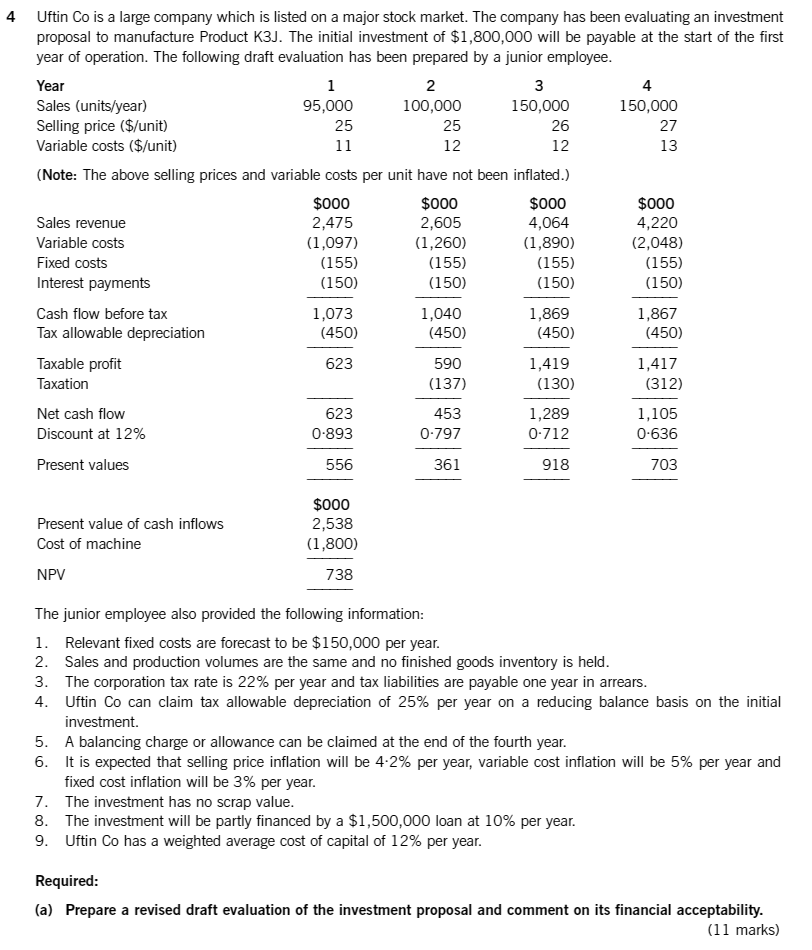
1217 others have taken this question
Question 4 b -
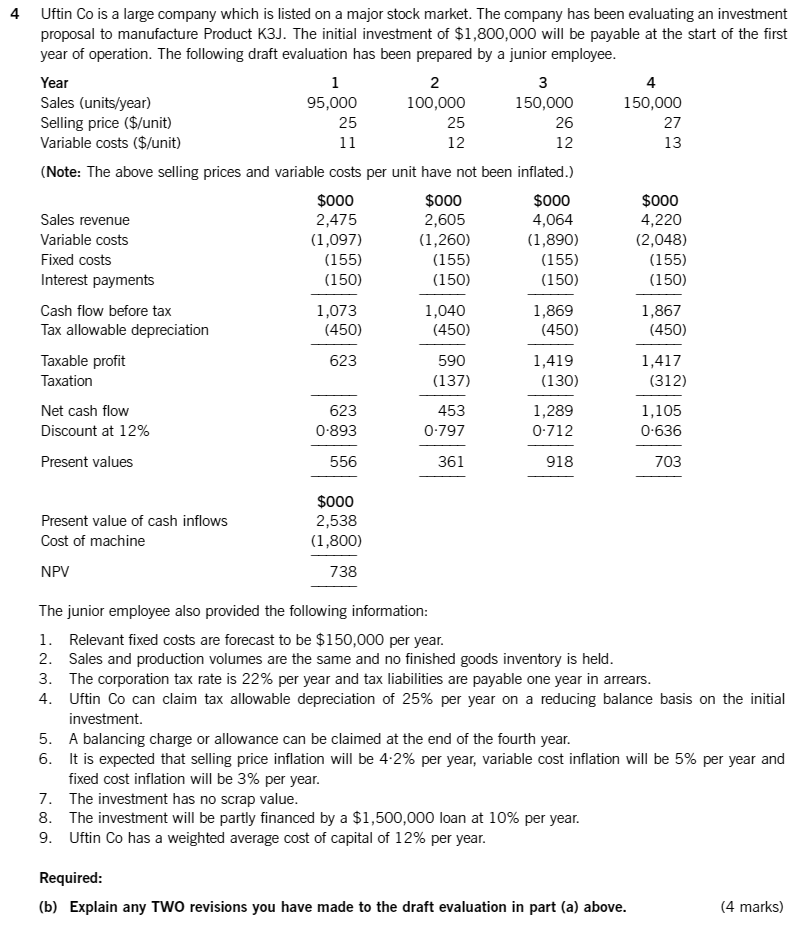
1164 others have taken this question
Question 4 a i - Specimen
PV Co is evaluating an investment proposal to manufacture Product W33, which has performed well in test marketing trials conducted recently by the company's research and development division. The following information relating to this investment proposal has now been prepared:
| Initial investment | $2 million |
| Selling price (current price terms) | $20 per unit |
| Expected selling price inflation | 3% per year |
| Variable operating costs (current price terms) | $8 per unit |
| Fixed operating costs (current price terms) | $170,000 per year |
| Expected operating cost inflation | 4% per year |
The research and development division has prepared the following demand forecast as a result of its test marketing trials. The forecast reflects expected technological change and its effect on the anticipated life-cycle of Product W33.
| Year | 1 | 2 | 3 | 4 |
|---|---|---|---|---|
| Demand (units) | 60,000 | 70,000 | 120,000 | 45,000 |
It is expected that all units of Product W33 produced will be sold, in line with the company's policy of keeping no inventory of finished goods. No terminal value or machinery scrap value is expected at the end of four years, when production of Product W33 is planned to end. For investment appraisal purposes, PV Co uses a nominal (money) discount rate of 10% per year and a target return on capital employed of 30% per year. Ignore taxation.
Required:
(a) Calculate the following values for the investment proposal:
(i) net present value; (5 marks)
1383 others have taken this question
Question 1 a -
The Board of OAP Co has decided to limit investment funds to $10 million for the next year and is preparing its capital budget. The company is considering five projects, as follows:
| Initial investment | Net present value | |
| Project A | $2,500,000 | $1,000,000 |
| Project B | $2,200,000 | $1,550,000 |
| Project C | $2,600,000 | $1,350,000 |
| Project D | $1,900,000 | $1,500,000 |
| Project E | $5,000,000 | to be calculated |
All five projects have a project life of four years. Projects A, B, C and D are divisible, and Projects B and D are mutually exclusive. All net present values are in nominal, after-tax terms.
Project E
This is a strategically important project which the Board of OAP Co have decided must be undertaken in order for the Company to remain competitive, regardless of its financial acceptability. Information relating to the future cash flows of this project is as follows:
| year | 1 | 2 | 3 | 4 |
| sales volume (units) | 12,000 | 13,000 | 10,000 | 10,000 |
| selling price ($/units) | 450 | 475 | 500 | 570 |
| variable costs ($/unit) | 260 | 280 | 295 | 320 |
| fixed costs ($000) | 750 | 750 | 750 | 750 |
These forecasts are before taking account of selling price inflation of 5•0% per year, variable cost inflation of 6•0% per year and fixed cost inflation of 3•5% per year. The fixed costs are incremental fixed costs which are associated with Project E. At the end of four years, machinery from the project will be sold for scrap with a value of $400,000. Tax allowable depreciation on the initial investment cost of Project E is available on a 25% reducing balance basis and OAP Co pays corporation tax of 28% per year, one year in arrears. A balancing charge or allowance is available at the end of the fourth year of operation.
OAP Co has a nominal after-tax cost of capital of 13% per year.OAP Co has a nominal after-tax cost of capital of 13% per year.
Required:
Calculate the nominal after-tax net present value of Project E and comment on the financial acceptability of this project. (14 marks)
1268 others have taken this question
Question 1 a -
Darn Co has undertaken market research at a cost of $200,000 in order to forecast the future cash flows of an investment project with an expected life of four years, as follows:
| Year | 1 | 2 | 3 | 4 |
|---|---|---|---|---|
| Sales Revenue ($000) | 1250 | 2570 | 6890 | 4530 |
| Costs ($000) | 500 | 1000 | 2500 | 1750 |
These forecast cash flows are before taking account of general inflation of 4•7% per year. The capital cost of the investment project, payable at the start of the first year, will be $2,000,000. The investment project will have zero scrap value at the end of the fourth year. The level of working capital investment at the start of each year is expected to be 10% of the sales revenue in that year.
Capital allowances would be available on the capital cost of the investment project on a 25% reducing balance basis. Darn Co pays tax on profits at an annual rate of 30% per year, with tax being paid one year in arrears. Darn Co has a nominal (money terms) after-tax cost of capital of 12% per year.
Required:
Calculate the net present value of the investment project in nominal terms and comment on its financial acceptability. (12 marks)
1226 others have taken this question
Question 1 a -
HDW Co is a listed company which plans to meet increased demand for its products by
buying new machinery costing $5 million. The machinery would last for four years, at the end of which it would be replaced. The scrap value of the machinery is expected to be 5% of the initial cost. Capital allowances would be available on the cost of the machinery on a 25% reducing balance basis, with a balancing allowance or charge claimed in the final year of operation.
This investment will increase production capacity by 9,000 units per year and all of these units are expected to be sold as they are produced. Relevant financial information in current price terms is as follows:

In addition to the initial cost of the new machinery, initial investment in working capital
of $500,000 will be required. Investment in working capital will be subject to the general rate of inflation, which is expected to be 4·7% per year.
HDW Co pays tax on profits at the rate of 20% per year, one year in arrears. The company has a nominal (money terms) after-tax cost of capital of 12% per year.
Required:
Calculate the net present value of the planned purchase of the new machinery using a nominal (money terms) approach and comment on its financial acceptability.
(14 marks)
1383 others have taken this question
Question 1 a -
BQK Co, a house-building company, plans to build 100 houses on a development site over the next four years. The purchase cost of the development site is $4,000,000, payable at the start of the first year of construction. Two types of house will be built, with annual sales of each house expected to be as follows:
| year | 1 | 2 | 3 | 4 |
| number of small houses sold | 15 | 20 | 15 | 5 |
| number of large houses sold | 7 | 8 | 15 | 15 |
Houses are built in the year of sale. Each customer finances the purchase of a home by taking out a long-term personal loan from their bank. Financial information relating to each type of house is as follows:
| small house | large house | |
| selling price | $200000 | $350000 |
| variable cost of construction | $100000 | $200000 |
Selling prices and variable cost of construction are in current price terms, before allowing for selling price inflation of 3% per year and variable cost of construction inflation of 4·5% per year.
Fixed infrastructure costs of $1,500,000 per year in current price terms would be incurred. These would not relate to any specific house, but would be for the provision of new roads, gardens, drainage and utilities. Infrastructure cost inflation is expected to be 2% per year.
BQK Co pays profit tax one year in arrears at an annual rate of 30%. The company can claim capital allowances on the purchase cost of the development site on a straight-line basis over the four years of construction.
BQK Co has a real after-tax cost of capital of 9% per year and a nominal after-tax cost of capital of 12% per year. New investments are required by the company to have a before-tax return on capital employed (accounting rate of return) on an average investment basis of 20% per year.
Required:
Calculate the net present value of the proposed investment and comment on its financial acceptability. Work to the nearest $1,000.
1295 others have taken this question
Question 1 a -
Ridag Co is evaluating two investment projects, as follows.
Project 1
This is an investment in new machinery to produce a recently-developed product. The cost of the machinery, which is payable immediately, is $1·5 million, and the scrap value of the machinery at the end of four years is expected to be $100,000. Capital allowances (tax-allowable depreciation) can be claimed on this investment on a 25% reducing balance basis. Information on future returns from the investment has been forecast to be as follows:
| year | 1 | 2 | 3 | 4 |
| sales volume (units/year) | 50000 | 95000 | 140000 | 75000 |
| selling price ($/unit) | 25.00 | 24.00 | 23.00 | 23.00 |
| variable cost ($/unit) | 10.00 | 11.00 | 12.00 | 12.50 |
| fixed costs ($/year) | 105000 | 115000 | 125000 | 125000 |
This information must be adjusted to allow for selling price inflation of 4% per year and variable cost inflation of 2·5% per year. Fixed costs, which are wholly attributable to the project, have already been adjusted for inflation. Ridag Co pays profit tax of 30% per year one year in arrears.
Project 2
Ridag Co plans to replace an existing machine and must choose between two machines. Machine 1 has an initial cost of $200,000 and will have a scrap value of $25,000 after four years. Machine 2 has an initial cost of $225,000 and will have a scrap value of $50,000 after three years. Annual maintenance costs of the two machines are as follows:
| year | 1 | 2 | 3 | 4 |
| machine 1 ($/year) | 25000 | 29000 | 32000 | 35000 |
| machine 2 ($/year) | 15000 | 20000 | 25000 |
Where relevant, all information relating to Project 2 has already been adjusted to include expected future inflation. Taxation and capital allowances must be ignored in relation to Machine 1 and Machine 2.
Other information
Ridag Co has a nominal before-tax weighted average cost of capital of 12% and a nominal after-tax weighted average cost of capital of 7%.
Required:
Calculate the net present value of Project 1 and comment on whether this project is financially acceptable to Ridag Co.
1366 others have taken this question
Question 1 a -
Warden Co plans to buy a new machine. The cost of the machine, payable immediately, is $800,000 and the machine has an expected life of five years. Additional investment in working capital of $90,000 will be required at the start of the first year of operation.
At the end of five years, the machine will be sold for scrap, with the scrap value expected to be 5% of the initial purchase cost of the machine. The machine will not be replaced.
Production and sales from the new machine are expected to be 100,000 units per year. Each unit can be sold for $16 per unit and will incur variable costs of $11 per unit. Incremental fixed costs arising from the operation of the machine will be $160,000 per year.
Warden Co has an after-tax cost of capital of 11% which it uses as a discount rate in investment appraisal. The company pays profit tax one year in arrears at an annual rate of 30% per year. Capital allowances and inflation should be ignored.
Required:
Calculate the net present value of investing in the new machine and advise whether the investment is financially acceptable.
1446 others have taken this question
buchananspreart1970.blogspot.com
Source: https://www.acowtancy.com/textbook/acca-fm/d1-investment-appraisal-techniques/npv/exam
0 Response to "Considering Question F9 Again What Is the Probability of Producing a Ponk Eyed Straig"
Post a Comment